
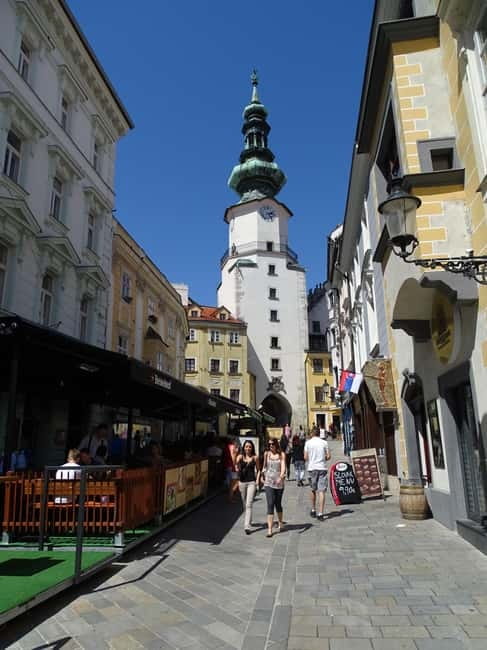
Reviewed · WALKING TOURS
Bratislava: Journey in Time Private Guided Walking Tour
Two thousand years in a 2-hour walk. This private guided journey through Bratislava links eras you usually see in separate museum rooms, from the Communist decades back to the medieval heart, with architecture and real people at the center. I like that the historian behind it, Juraj Polacek, is also a medievalist and culture, art, and wine lover, so you get stories that connect buildings to lives, not just dates.
I also love the format for questions: you get a 2-hour private tour with up to 30 extra minutes if you are the curious type. One consideration, though, is simple: it is a walking tour with no entrance fees included, so if you want lots of indoor time, you may need to plan that separately.
In This Review
- Key things to know before you go
- A Time-Travel Walk Through Bratislava, 20th to 1st
- Juraj Polacek Makes the Buildings Talk
- Meeting Points That Fit Real Travel Days
- 1950s-80s Bratislava: Communist Decades and a New Kind of Modern
- Interwar Czechoslovak Functionalism: Where a Bright Passage Signals Change
- Pressburg Under Franz Joseph: Hviezdoslav Square and the Belle Epoque Mood
- Town Hall, Franciscan Church, and St Martins´ Church
- The Oldest Street in Central Europe and Celtic Roots
- Price and Value: $176 Per Group Up to 6
- Who Should Book This Tour
- Should You Book This Bratislava Journey in Time Walking Tour?
- FAQ
- How long is the Bratislava Journey in Time private guided walking tour?
- What is the price for the tour?
- Is this tour private or shared?
- What languages are available for the live guide?
- Where can we meet for the tour?
- Are entrance fees included?
Key things to know before you go
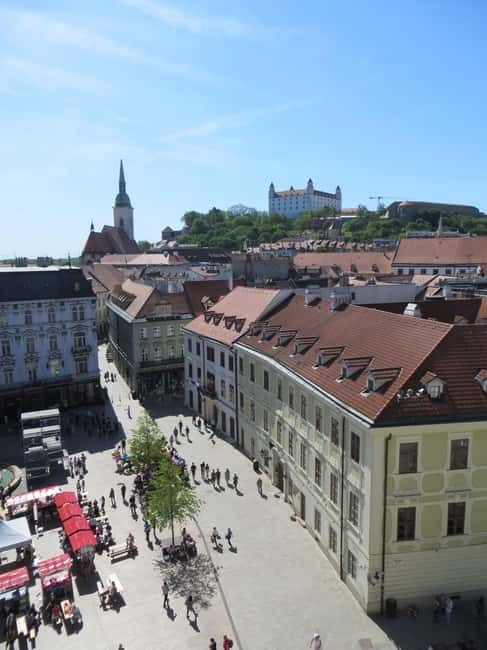
- Private group up to 6, so you can ask questions without yelling over the crowd.
- Juraj Polacek brings a historian-medievalist angle, plus culture, art, and wine interests.
- A time travel route: Communist decades, interwar functionalism, Hungarian Kingdom Pressburg, then 18th century and the Middle Ages.
- Focus on architecture as evidence of each era, not just scenic stops.
- Extra time included: up to 30 minutes beyond the main tour if you want more.
- Meeting options: hotel pickup in the city center, or Primacialne namestie near the Tourist Information Centre.
A Time-Travel Walk Through Bratislava, 20th to 1st
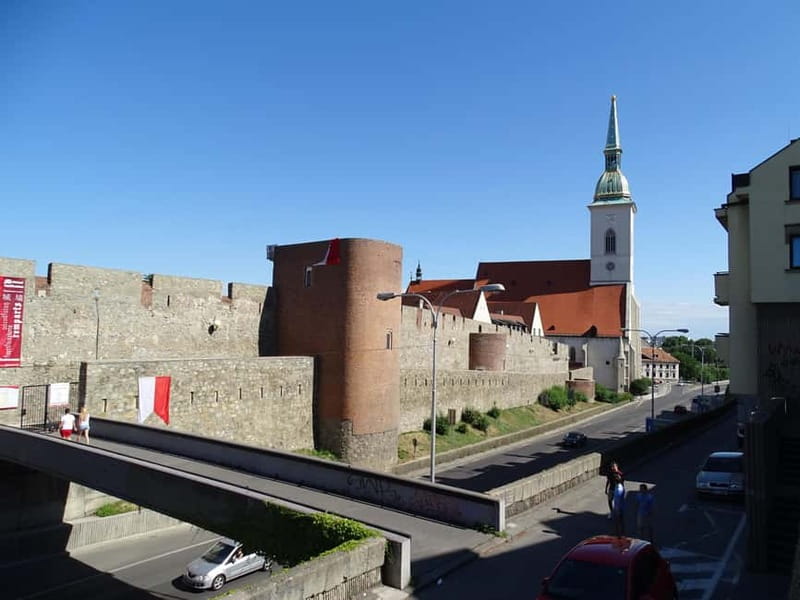
This tour is built like a rewind button. You start in the 20th century and move backward, watching Bratislava try to be modern again and again, even when politics tried to steer the city in a different direction. I like that it frames the town as a place shaped by changing tastes and power, not just one static old town postcard.
You will begin with the Communist decades and how they shaped the once romantic Danube town. Then you head into the interwar period, where Czechoslovakia’s new identity shows up in functionalist architecture and a brighter, more practical urban mood. After that comes the long Hungarian Kingdom chapter, when Bratislava, also known as Pressburg, developed as a seat of palaces and major musical life.
By the time you reach the medieval sites, the walking pace slows mentally, even if your legs do not. The Middle Ages are presented as a first golden age, with key landmarks that anchor the story. And right after St Martins´ Church, you get an especially cool layer: you will be pointed toward what is described as the oldest street in Central Europe, with Celtic roots behind that medieval heart.
More of Bratislava on foot in an afternoon:
- Bratislava: 1-Hour Small Group Walking Tour
★ 4.4 · 379 reviews - Bratislava City & Castle Walking Tour with Sebastian in English
★ 5.0 · 289 reviews - Bratislava: Private Walking Tour with Optional Beer Tasting
★ 4.7 · 214 reviews - Bratislava walk tour with bonuses and castle 3€ + Tip, kids free
★ 5.0 · 191 reviews - Bratislava: 2- Hour Private Walking Tour
★ 4.5 · 118 reviews
Juraj Polacek Makes the Buildings Talk
This is not a generic walk with a few facts stitched in. Juraj Polacek is a historian and medievalist, and you can feel that training in how he connects architectural features to what people were actually doing and believing during the 15th-20th century window he focuses on.
He also brings culture, art, and wine love into the mix. That matters because it changes the kinds of questions you end up asking. Instead of only thinking about who ruled, you start thinking about what daily life felt like, what people valued aesthetically, and how tastes and ideas moved through the city.
The tour promise includes stories hidden in old sources and known to experts. I take that as a sign that you will hear details that are not the usual top-three bullet points. Even better, the included extra time makes it realistic to follow the tangents that catch your interest, instead of being cut off mid-thought.
Meeting Points That Fit Real Travel Days
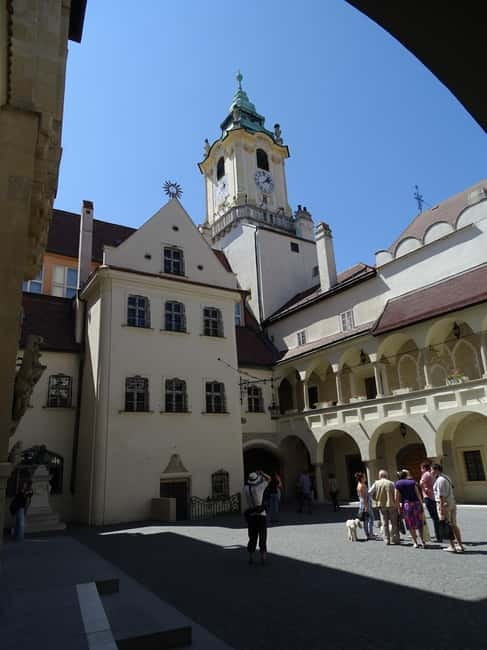
Logistics can make or break a good walking tour, especially in a compact city. This one gives you practical options. The best start is your hotel in the centre, which means you can roll out with less hassle. If you prefer to meet on the street, there is also a pickup option around Bratislava hl.st and in the Old Town area.
Another straightforward meet point is in front of the Tourist Information Centre at Primacialne namestie. That option is helpful if you are already nearby or you want the exact same start place each time.
The tour runs for 2 hours, so you will want to begin on time. If you tend to stop for photos every five minutes, build in a little cushion so you do not feel rushed. The upside is that the route is designed for continuity, so even if you are taking pictures, you are moving through the city’s story rather than bouncing between random stops.
1950s-80s Bratislava: Communist Decades and a New Kind of Modern
You start with the Communist decades, when the city’s look and priorities were reshaped. The tour is explicit about showing examples of architecture from the 1950s-80s in the Old Town, and that is where the guided part pays off. If you try to interpret those buildings alone, it is easy to miss what is visible at street level: how planning decisions show up in proportions, layouts, and the overall feel of public spaces.
The framing here is interesting. Bratislava is described as a town that wanted to be modern and sought contemporary artistic and urbanistic trends. Under Communism, those impulses did not disappear, but they were filtered through the era’s rules and ideals. In practice, you will be using the guide’s direction to read what you see as a historical document, not just a backdrop.
This first segment also sets your expectations for the rest of the walk. You start noticing how quickly “modern” changes across decades, which makes the later interwar functionalism and belle epoque sections click much faster.
Interwar Czechoslovak Functionalism: Where a Bright Passage Signals Change
Next comes the interwar period, tied to creation of Czechoslovakia after WWI. The tour moves you to a lovely bright passage typical for Czechoslovak functionalism, and that word is not thrown around for decoration.
Functionalism is basically an argument in architecture: shape should follow use, and the city should feel rational and forward-looking. In this part of the tour, you get to connect that idea to a specific moment in political identity. After WWI, Czechoslovakia was building a new self-image, and the architecture becomes part of the public message.
You do not just pass by buildings here. The guide focuses on architecture as evidence of an era, so you can compare what came before and what comes next. One practical benefit for you: when you later walk around Bratislava on your own, you will spot which features feel interwar versus later or earlier, instead of treating the old town as one blended block.
More Bratislava trips to line up against this one
- Bratislava: 2-Hour Private Walking Tour★ 4.6 · 64 reviews
- Private Bratislava Grand City Tour★ 4.5 · 51 reviews
- Highlights of Bratislava – Old Town with Castle private tour★ 5.0 · 34 reviews
- Private Day Trip to Banska Stiavnica Unesco Site★ 5.0 · 30 reviews
Pressburg Under Franz Joseph: Hviezdoslav Square and the Belle Epoque Mood
Now the tour shifts into the Hungarian Kingdom period, when Bratislava served as the capital from the 16th to the 19th century. You also get the alternate name, Pressburg, and that naming is more than trivia. It signals how the city’s cultural identity and power structures changed over centuries, and it prepares you to understand why later landmarks feel tied to Central European grandeur.
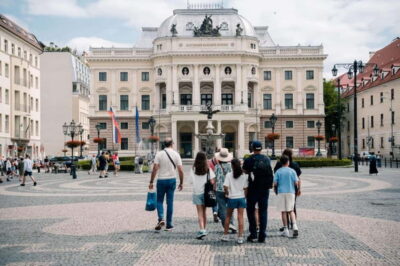
You start this big chapter with Hviezdoslav Square and the Opera House. The tour specifically links this to the belle epoque during Franz Joseph’s rule. That is a useful anchor. When a guide points you to a major cultural building like the Opera House, you learn to read the city not only as a fortress-and-church place, but as a center for performances, composers, and public life.
Then you walk toward what is described as an aristocratic 18th century town, including the High Streets tied to palaces and great composers and musicians. Even if you do not think of yourself as a music history person, this section tends to pull you in because it explains why the city’s streets and buildings were shaped for public presence, not only defense or trade.
Town Hall, Franciscan Church, and St Martins´ Church
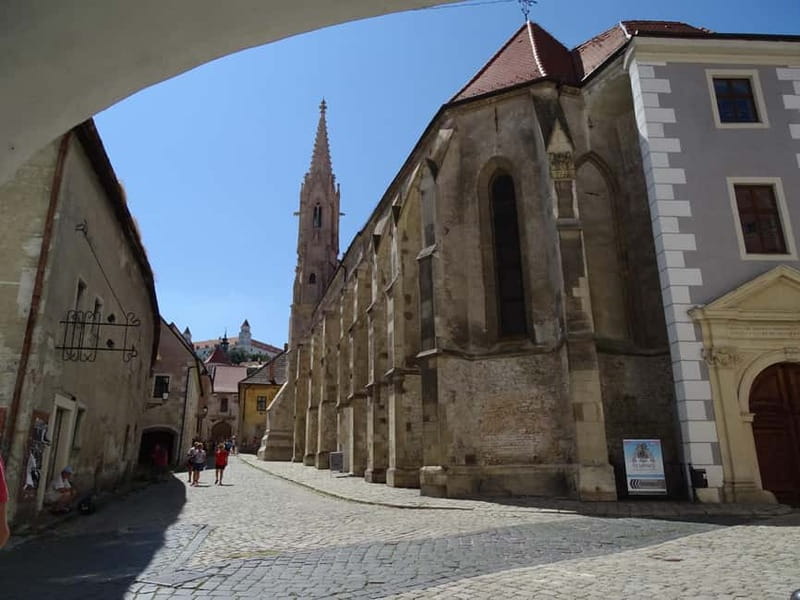
You are then guided into what the tour calls the first golden age, the Middle Ages. This is where the architecture stops being a timeline and becomes a set of anchors. The guide does not skip the landmarks that hold the medieval story together.
You will visit the Town Hall, the Franciscan Church, and St Martins´ Church. If you only had time to see one or two churches in Bratislava, I would still treat this stop as the core, because St Martins´ Church is singled out in the route plan, and it is positioned as the turning point into the medieval heart.
The practical value of having these stops guided is that you are not just looking at pretty facades. You are learning what makes each building a strong example of its era. That changes the way you photograph. Instead of aiming for symmetry only, you start noticing how the building fits into its surrounding space and what it suggests about the society around it.
Also, the tour includes stories about people who lived in Bratislava from the 15th to the 20th century. Those people make the medieval sites feel like homes and workplaces, not just preserved monuments.
The Oldest Street in Central Europe and Celtic Roots
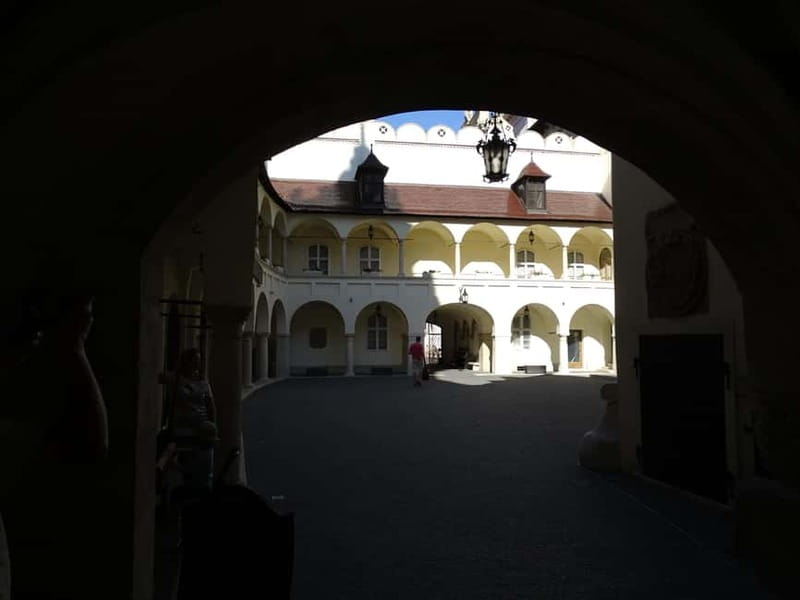
Right behind St Martins´ Church, the tour takes you to what is described as the probably oldest street in Central Europe. That kind of claim is exactly where a good guide helps you stay grounded. The point is not to argue history in the street. The point is to give you a place where multiple layers of time overlap, and you can feel that depth in the street shape and the sense of continuity.
From there, you get directed toward the medieval heart of Bratislava and its Celtic roots. The tour frames it as more than 2000 years of history in a single walk, and this section is where that statement stops being poetic and starts feeling physical.
If you like “how did this place get here” thinking, this is the moment you will remember. It is also where the private format matters most. In a group, people tend to rush. In a private group, you can take an extra few minutes at the street level to let the layers sink in, then keep moving.
Price and Value: $176 Per Group Up to 6
Let’s talk money with real math. The cost is $176 per group up to 6 people for a duration of 2 hours. If you book with a full group of 6, that is about $29 per person. If it is just 2 people, it becomes about $88 per person.
So when is it good value? It is a strong deal when:
- you travel with friends or family and want a shared experience
- you care about explanations tied to architecture and historical periods
- you want practical recommendations after the walk
One of the best value signals is the extra time. Up to 30 minutes is included if you are curious and ask questions. That is not just a comfort perk. It means you can cover the topics that matter to you, like where the city’s aesthetic shifts show up or what to prioritize if you only have a day.
Also, the guide provides practical information, including suggestions for restaurants and other places to see. That kind of add-on can pay for itself quickly, especially if you are trying to plan the rest of your Bratislava day.
Who Should Book This Tour
You should book this if you:
- like medieval and Central European history, but want it tied to real places you can see
- enjoy architecture explanations, not only dates
- want a private walk rather than a large group shuffle
- prefer a guide who can answer follow-up questions without cutting you off
You might not love it as much if you want a tour with heavy indoor museum time. This one is built around walking and observing. It can include entrance-to-entrance experiences if you arrange them separately, but from the structure you can expect the core value is the guide’s interpretation while you move.
It also suits travelers who enjoy culture beyond monuments. The guide’s culture, art, and wine interests are part of the feel of the tour, and that can add personality to what could otherwise be a straight timeline.
Should You Book This Bratislava Journey in Time Walking Tour?
Yes, if your ideal Bratislava day is a guided storyline: Communist decades to interwar Czechoslovakia to Pressburg belle epoque to the medieval core. The private format, the historian-medievalist perspective of Juraj Polacek, and the architecture-first approach are what make it worth your time.
If you have limited time and you want a plan that teaches you how to read the city quickly, this is a smart choice. Just bring comfortable shoes, since you are earning that 2000 plus years of context one step at a time.
FAQ
How long is the Bratislava Journey in Time private guided walking tour?
The tour lasts 2 hours.
What is the price for the tour?
The price is $176 per group, up to 6 people.
Is this tour private or shared?
It is a private group tour.
What languages are available for the live guide?
The live tour guide is available in English, Italian, Croatian, and Slovak.
Where can we meet for the tour?
The best meeting point is your hotel in the centre, or you can meet in front of the Tourist Information Centre at Primacialne namestie. There are also pickup options including Bratislava hl.st., Old Town, and Primate’s Square.
Are entrance fees included?
No, entrance fees are not included, and food and drinks are also not included.
New in the Bratislava listings
Walking Tours, compared.
Bratislava City & Castle Walking Tour with Sebastian in English
Read our review →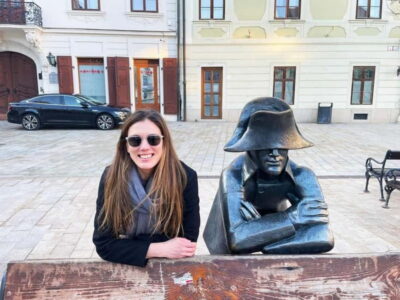
Private Walking Tour with Optional Beer Tasting
Read our review →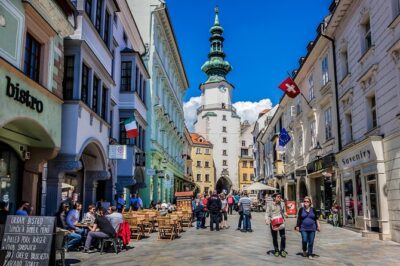
Bratislava walk tour with bonuses and castle 3€ + Tip, kids free
Read our review →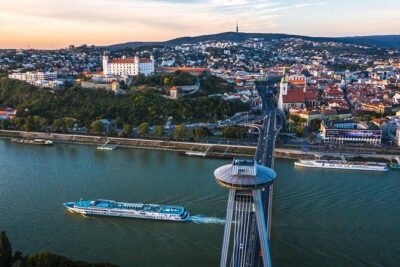

Bratislava Card with Public Transport Option & Walking Tour
Read our review →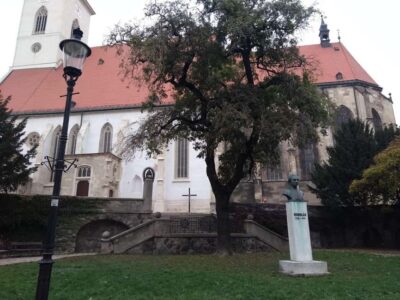
Browse the lists this tour appears in